Paintless Dent Repair in Ontario: How PDR Works
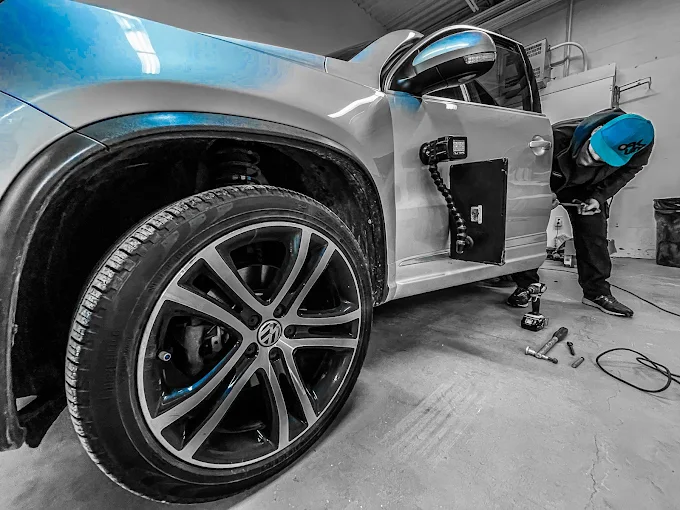
Paintless dent repair removes a dent by reshaping the metal from behind the panel with specialised rods and tapping tools, so the factory paint is never sanded, filled or resprayed. It works whenever the paint is unbroken, takes hours instead of days, and leaves no refinish work on the vehicle's record.
Every dent has a memory. When a panel is pressed at the factory the steel or aluminum is stretched into shape and locked there; an impact does not delete that shape, it displaces it. Paintless dent repair works by releasing the displacement in the reverse order it happened — the high tension points first, then the crown, then the fine surface waves — until the metal settles back where it wants to be.
That is a fundamentally different idea from what a collision shop does. A body shop's process assumes the panel cannot be returned to shape, so it makes the surface flat again with filler and hides the repair under new paint. That works, but it costs you the factory finish, several days, and a permanent refinish note on the vehicle.
Between our Burlington and Hamilton shops we have repaired more than 100,000 vehicles with over 75 combined years on the tools. This page explains the process honestly, including where PDR is the wrong answer.
What paintless dent repair can fix
- Door dings and shopping-cart dents, the single most common repair we do
- Hail damage, from a dozen dents to several hundred across every horizontal panel
- Creases and body-line dents, including sharp ones other shops decline
- Large dents from bikes, ladders, garage doors and low-speed contact
- Hood, roof, tailgate and quarter-panel damage on both steel and aluminum
- Dealership lot damage and trade-in reconditioning before resale
When PDR is not the right answer
We will tell you when it is not. If the paint is cracked, chipped or scraped down to primer, the finish is already compromised and pushing the metal back will not restore it — that vehicle needs refinish work, and the honest recommendation is a body shop.
Damage on a panel edge or on a double-layer structure such as a door frame can be beyond reach, and severely stretched metal from a high-energy impact may not return cleanly. Panels that have already been filled and repainted are also unpredictable, because filler does not move the way metal does.
Roughly nine out of ten dents that walk through our door are PDR candidates. For the other one, you get a straight answer and no charge for the look.
The process, step by step
- Assessment under reflective lighting, the only way to see the true dent count and depth
- Access — removing interior trim, a tail light, or a liner to reach the back of the panel
- Reshaping, working from the outside of the dent inward with rods sized to the access point
- Glue pulling where there is no access behind the panel, using tabs bonded to the paint
- Blending and reading the surface with a line board until the reflection is dead straight
- Reassembly and a final inspection with you standing beside the car
Why it protects the value of your vehicle
Factory paint is applied by robots in a controlled booth and baked at temperatures no aftermarket shop can replicate. It is measurably harder, more uniform and longer-lived than any respray. Once it comes off a panel, it never comes back.
A respray also introduces a colour-match problem that gets worse with time. Even a perfect blend on day one ages differently from the surrounding factory finish, and metallics and pearls are the hardest to match. Three years later the repaired panel is visible in direct sun.
And refinish work leaves a trail. Paint depth readings, a Carfax entry and a dealer's paint gauge at trade-in all flag a repainted panel, and appraisers discount for it. PDR leaves nothing to find because nothing was added to the car.
What this looks like on a real vehicle
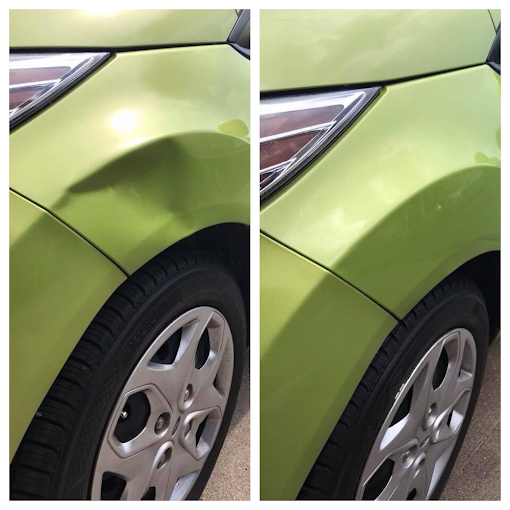
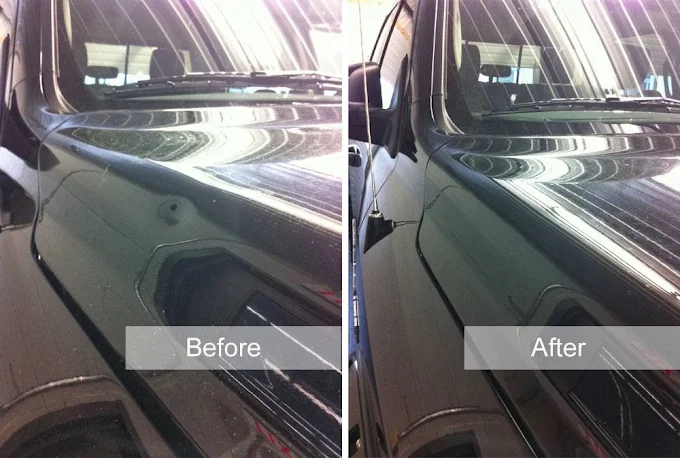
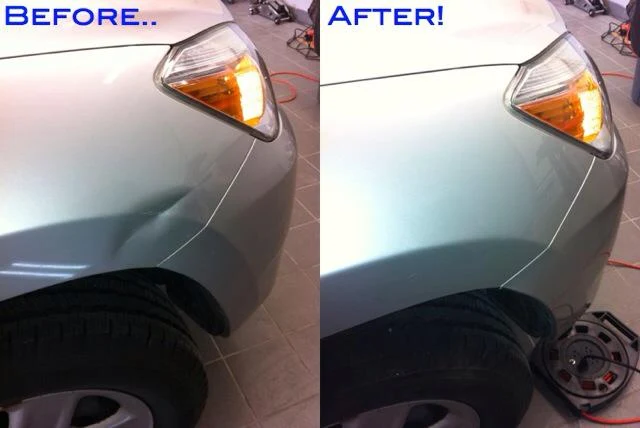
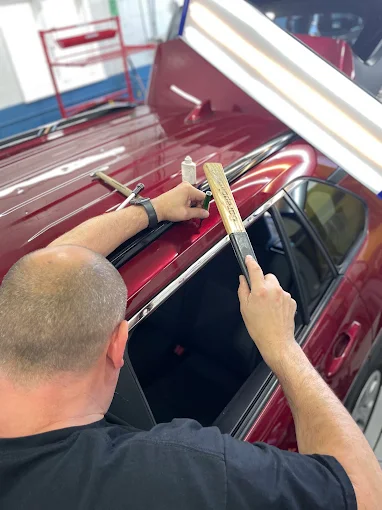
Every photo is a Precision Dent Repair job from our Burlington or Hamilton shop. See the full gallery →
What customers say
"When my vehicle was recently damaged by a severe hailstorm, it ended up with a significant number of dents across the body. After contacting my insurance company, I was initially referred to a general body shop. However, since this was strictly dent-related damage, I wanted to find a shop that truly specializes in paintless dent repair. That's when I came across Precision Dent Burlington."
"I had my brand new car destroyed by hail damage back in August. The car was covered in dents in pretty much all areas — roof, hood, rails, doors, trunk, quarter panel, fenders. I researched a few places and even went to another highly reviewed shop to get an estimate. The other shop started mentioning paint and parts."
"Andreas and his team were great! Very quick and transparent! Andreas was especially helpful in dealing with my difficult insurance in the process of getting the repair approved. Despite heavy hail damage, the car looks brand new now!"
"Great experience dealing with these guys. Very friendly and accommodative and their work is very impressive. Had them repair two BMW's with hail damage and they both looked new when they were done."
"I had several dents in my Yukon Denali after a major hail storm. Thanks to the efficient service of Precision Dent Repair, my vehicle looks as good as new again. I would highly recommend this company!"
"Great experience from start to finish, they accommodated my schedule and took care of everything through insurance. Easy process and repaired a ton of damage from a hail storm. Highly recommend."
Certified technicians. Seven award years.
Independently certified in paintless dent repair and high-voltage vehicle safety — and recognized by customers year after year.
Award-winning service, 2019 – 2026
Recognized for outstanding customer service & technical proficiency
Common questions
Will the dent come back?
No. Once the metal is returned to its original shape it is stable — the panel is back to the geometry it was pressed into. A correctly finished PDR repair is permanent.
Can you tell a dent was ever there?
On a properly finished repair, no. We check the surface with a reflective line board, which shows distortion the naked eye cannot. If the reflection runs straight, the panel is straight.
How long does it take?
A single dent is typically 30 to 90 minutes. Several dings take a few hours. A hail-damaged vehicle is usually one to three days depending on dent count and how much disassembly the panels need.
Does paintless dent repair work on aluminum?
Yes, but it is harder and takes longer. Aluminum has far less memory than steel, so it must be worked slowly with controlled heat and different tooling. Both our shops handle aluminum panels on F-150s, Audis and EVs regularly.
How much does it cost?
Single door dings commonly land in the $150 to $350 range, larger or more complex dents higher, and hail is quoted by dent count and panel. See our cost breakdown page for real ranges.
Is PDR cheaper than a body shop?
Almost always, and often by a wide margin, because there is no filler, no paint, no booth time and no multi-day labour. But cost is the second reason to choose it. The first is that your factory paint stays on the car.
Related pages
Two shops. Same craft.
Burlington
Burlington, ON L7L 5Z7
Mon–Fri 9:00 AM – 5:00 PM
Hamilton
Hamilton, ON L8W 3N7
Mon–Fri 9:00 AM – 5:00 PM
Send a photo. Get a real number.
Most quotes come back the same day. No obligation, no pressure, no body shop upsell.